Library Finals Hours, Winter Term 2022
Sunday, March 13: 11am – 10pm;
Monday, March 14: 8am – 10pm;
Tuesday, March 15: 8am – 10pm.
Library Break Hours
Wednesday, March 16 – Sunday- March 27
Monday – Friday: 9am – 4pm
Saturday – Sunday: CLOSED
Library Finals Hours, Winter Term 2022
Sunday, March 13: 11am – 10pm;
Monday, March 14: 8am – 10pm;
Tuesday, March 15: 8am – 10pm.
Library Break Hours
Wednesday, March 16 – Sunday- March 27
Monday – Friday: 9am – 4pm
Saturday – Sunday: CLOSED

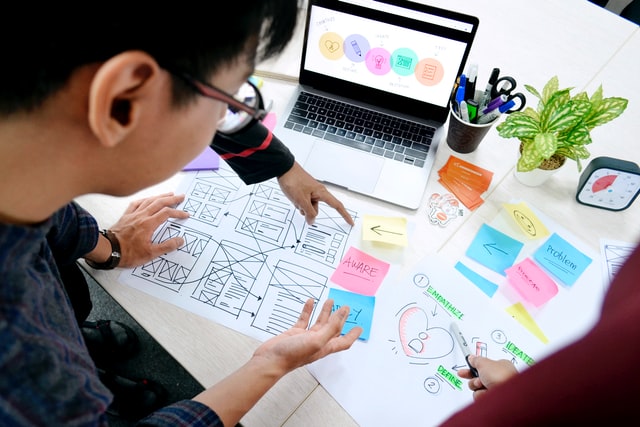
Participate in this Spring’s usability testing for the Library website!
We’re looking for 5 students to put our library website to the test. Participants that are chosen will receive one of five prizes for 30-45 minutes of their time.
Visit the Usability Testing Sign-Up page for what to expect, prize options, requirements and the testing volunteer form (1 minute or less to complete). If you are selected as a participant we will connect with you to arrange a time to meet virtually in the Spring.
For questions please contact Katrina Frank at Katrina.Frank@kzoo.edu.
AntiRacism Reading Knook
Please join Amelia Katanski on Tuesday, March 15th from 4:10 – 5 p.m in the ARRK Teams Meeting Space. The discussion will be about surrounding the concept of how settler colonialism interacts with–and potentially adds complexity to–the way we think of antiracism work. The discussion will also begin with the first 16 pages of Daniel Heath Justice’s, Why Indigenous Literatures Matter (visit the ARRK Meeting Space for a downloadable PDF of the intro) and/or the 7 minute video, What is Settler Colonialism?
For further details on the AntiRacism Reading Knook, see the ARRK (AntiRacism Reading Knook) on the Inclusive Excellence website.
The AntiRacism Reading Knook (ARRK) is a collaboration between the K College library staff and our Inclusive Excellence (KCIE) leadership team. This initiative is NOT a book club, but seeks to facilitate campus-wide engagement with the books in the KCIE Reading for Change book collection. This collection was created to encourage learning about and facilitate greater access to antiracism information to all members of the campus community.
For further information on #ARRK see the KCIE AntiRacism Reading Knook page. To volunteer to lead one of these sessions complete the ARRK Discussion Leader application.
The Library’s display for Women’s History Month centers on readings on, about, and by women. Check out our display in person in the lobby of the Library, or virtually here:
Readings On, About, and By Women
You can learn more about Women’s History Month through events sponsored by the Library of Congress, National Archives and Records Administration, National Endowment for the Humanities, National Gallery of Art, National Park Service, Smithsonian Institution and United States Holocaust Memorial Museum. The Women’s History Museum also has a wealth of information, including virtual exhibits, articles, and more.

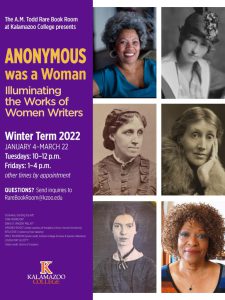
The A.M. Todd Rare Book Room at the Kalamazoo College Library is hosting an exhibit of women writers for the Winter 2022 term. The exhibit features works from Toni Morrison, Edna St. Vincent Millay, Virginia Woolf, Rita Dove, Emily Dickinson, and Louisa May Alcott.
Come check it out in Room 326!
Date: January 4 – March 22
Day/Time: Tuesday: 10 a.m.-12 p.m., Friday: 1 p.m.-4p.m., other times by appointment
The rare book collection contributes to the educational program of the college by introducing students to unique primary source materials in the context of their academic course work and through regularly scheduled public exhibitions.
Questions? Contact rarebookroom@kzoo.edu.

The Library of Michigan has announced this year’s Michigan Notable Books!
From the Library of Michigan: Every year, the Library of Michigan selects up to twenty of the most notable books, either written by a Michigan resident or about Michigan or the Great Lakes. Each selected title speaks to our state’s rich cultural, historical, and literary heritage and proves without a doubt that some of the greatest stories are found in the Great Lakes State.
Find the list and more about the Michigan Notable Books program at www.Michigan.gov/NotableBooks
K College students, faculty, and staff looking to engage with antiracist ideas and practices can find resources at the Library!
Kalamazoo College Inclusive Excellence (KCIE) has purchased and recommends the Reading for Change book collection. These materials are featured on the Reading for Change Guide. All are available through the Kalamazoo College Library!
These materials were purchased through the Howard Hughes Medical Institute’s Inclusive Excellence Grant.

The Library of Congress recently made personal papers of Rosa Parks available online, for free.
The collection contains approximately 7,500 manuscripts and 2,500 photographs. It documents many aspects of Parks’s private life and public activism on behalf of civil rights for African Americans. The collection includes the years 1866-2006.
Many of Parks’s writings describe the events surrounding her arrest in 1955 after she refused to give up her seat on a bus to a white passenger, as well as the Montgomery Bus Boycott. Her papers also include writings on Parks’s work in Congressman John Conyers’s Detroit office; her participation in major civil rights events such as the Prayer Pilgrimage for Freedom in 1957, March on Washington for Jobs and Freedom in 1963, Mississippi Freedom Project in 1964, and the Poor People’s Campaign in 1968; and Parks’s Presidential Medal of Freedom and Congressional Gold Medal.
The collection also documents Parks’s affiliation with organizations such as the Rosa and Raymond Parks Institute for Self Development; Hampton Institute; Highlander Folk School; Martin Luther King, Jr. Center for Nonviolent Social Change; National Association for the Advancement of Colored People; Southern Christian Leadership Conference; and Saint Matthew African Methodist Episcopal Church, Detroit, Michigan.
AntiRacism Reading Knook
Please join Alison Geist and Regina Stevens-Truss on Tuesday, February 15th from 4:10 – 5 p.m in the ARRK Teams Meeting Space. The discussion will be about structural and systemic racism as social determinants of health and disease.
For further details on the AntiRacism Reading Knook, see the ARRK (AntiRacism Reading Knook) on the Inclusive Excellence website.
The AntiRacism Reading Knook (ARRK) is a collaboration between the K College library staff and our Inclusive Excellence (KCIE) leadership team. This initiative is NOT a book club, but seeks to facilitate campus-wide engagement with the books in the KCIE Reading for Change book collection. This collection was created to encourage learning about and facilitate greater access to antiracism information to all members of the campus community.
For further information on #ARRK see the KCIE AntiRacism Reading Knook page. To volunteer to lead one of these sessions complete the ARRK Discussion Leader application.

Kalamazoo Public Library’s 2022 Reading Together title is The Best We Could Do: An Illustrated Memoir by Thi Bui.
Several events are scheduled, starting Saturday, February 12, on KPL Live and on Zoom. The author will speak at 7 pm on Tuesday, March 22, 2022 on KPL Live. This event is free and open to the public.
This beautifully illustrated and emotional story is an evocative memoir about the search for a better future and a longing for the past. Bui documents the story of her family’s daring escape after the fall of South Vietnam in the 1970s, and the difficulties they faced building new lives for themselves.
You can get The Best We Could Do on our shelves, or through the Kalamazoo Public Library or MeLCat if the K College Library copy is checked out.
About Reading Together
The purpose of Reading Together is to build a stronger community with deeper connections through the common experience of reading the same book and exploring its themes together. When we do that, we engage and learn, not only about ourselves, but more importantly about each other and the world around us.
By experiencing the same book, hearing the author of that work speak right here in Kalamazoo, and examining the book’s themes through a local lens, we are able to embrace our similarities and differences from a common point of reference.
Very simply, when we read together, we grow together.